Abdul's Story
If someone had told me a few years ago that I would leave an established career to become a student again, I probably wouldn't have believed them.
My name is Dr Abdul Razzaque, and I came to the University of Birmingham from Sindh, Pakistan, to study Public and Environmental Health. While Birmingham became my classroom, the real reason for my journey began over thousands of miles away in Tharparkar, my home district, one of Pakistan's most underserved desert regions.
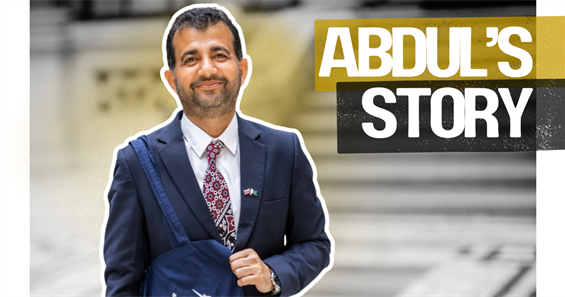
Where my journey began
As a medical and public health professional, I worked with communities in my area facing challenges that couldn't be solved with medicine alone. Women, adolescents and families were struggling with anxiety, depression and emotional distress, but these problems rarely existed in isolation. They were often rooted in poverty, unemployment, food insecurity, limited educational opportunities, and the daily uncertainty of living in an area where even basic needs are difficult to meet.
That changed the way I thought about public and environmental health.
I realised that if I wanted to make a meaningful contribution, I needed to understand not only health systems, but also how different countries prevent illness, promote wellbeing and build resilient communities. I wanted to learn globally so I could act locally.
That vision became the foundation of my career plan and my application for the Chevening Scholarship. Receiving a fully funded Chevening Scholarship wasn't simply financial support but it was an opportunity to learn from one of the world's leading university and from people whose experiences were completely different from my own.
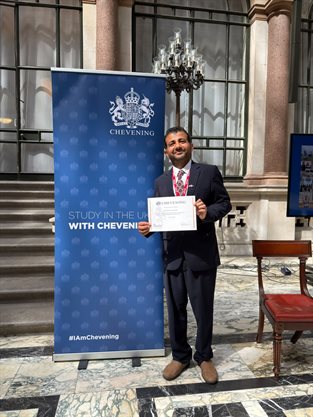
Starting over again in the UK
Coming to Birmingham was exciting, but it was also humbling.
Back home, I was already an experienced healthcare professional. Here, I was once again a student, adapting to a different education system, new ways of thinking, and a multicultural environment where every conversation offered another perspective.
One of the greatest lessons I've learned hasn't come from a textbook.
It has come from listening.
Inside classrooms, group projects, volunteering, and conversations with classmates from around the world, I discovered how different societies approach similar mental health challenges. Some communities focus on early intervention. Others strengthen schools, workplaces, or community networks. Although every country faces different realities, one message kept emerging: sustainable improvements in mental health require more than healthcare alone. They require collaboration across education, policy, communities, and social support.
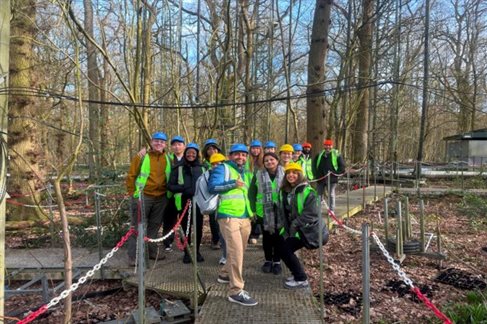
Abdul on an academic tour to BiFOR (Birmingham Institute of Forest Research)
Those conversations continually reminded me that no country has all the answers, but every country has something worth learning from.
More than a degree
Alongside my studies, I was determined to contribute beyond the classroom. I served as a Guild Representative and University Ambassador, took part in the Master's Consultancy Challenge, and worked with fellow students to carry out sustainability audits of laboratories across the University, exploring practical ways to improve environmental performance. Volunteering also became one of the most rewarding parts of my Birmingham experience. I supported organisations including HOPE for Epilepsy, Cancer Research UK, the British Islamic Medical Association, the British Heart Foundation and several community initiatives, believing that learning should always be accompanied by giving back.
These experiences broadened my perspective, strengthened my leadership and teamwork skills, and deepened my understanding of communities very different from my own. Receiving the Foreign, Commonwealth & Development Office (FCDO) Volunteering Award and the University of Birmingham Award with Distinction were meaningful milestones not simply because they recognised what I had achieved, but because they reflected the values that brought me to Birmingham in the first place: service, curiosity and a commitment to creating positive change. Looking back, the biggest transformation wasn't collecting another qualification.
It was learning to see public health through a global lens while never losing sight of where I came from.
My ambition remains the same as the day I applied for Chevening: to contribute to stronger, more equitable approaches to mental health in underserved communities like Tharparkar by combining evidence, collaboration and the lessons I've gained from around the world.
My advice to you
Before I finish, I'd also like to thank Dr Daniel Drage, my Programme Lead, who was incredibly approachable from the very beginning. Even while I was deciding whether to pursue my MSc at Birmingham, he took the time to answer my questions and offer guidance. His continued support throughout my studies made a lasting difference to my experience.
If you're reading this and wondering whether leaving your comfort zone is worth it, my answer is simple.
The journey may take you thousands of miles from home, but if you stay connected to your purpose, it has a way of bringing you closer to the impact you always hoped to make.
Have a story to tell? Contact us at studentcommunications@contacts.bham.ac.uk.