#UoBWomen: Breaking taboos as a British-Indian Hindu activist
Written by Anvi Gupta
Growing up, periods and menstrual health was a bit of a taboo in the community. Despite going to all-girls primary and secondary schools, we had code names that we used and would avoid telling male PE teachers why we weren’t swimming. I had seen from my interactions with my peers that it was perceived as a ‘girls’ thing’ - something that you don’t talk about with uncles and men in the community.
Little did I realise at the time, these observations would lead me to being invited at 10 Downing Street for Diwali 5 years later.
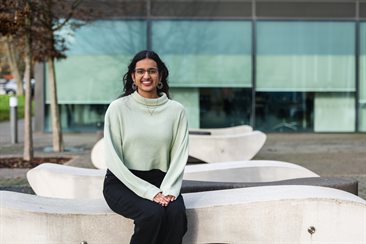
I’m Anvi, a third-year Liberal Arts and Natural Sciences student. When I was 15, I decided to bring the matter of not having free period products for students and staff to the Senior Leadership Team. This marked my first step as a menstrual health activist. I started raising other important matters such as period products taught in menstrual health curriculum, the language used on labels on the bins in the cubicles and raising awareness around menstrual health beyond just periods in biology lesson. I quickly created a community of students who even fundraised for charities and hosted a period product drive.
After leaving school
When I left school, I knew during the last couple of years there was still one thing I was scared to talk about. That was being a British-Indian Hindu.
Behind the confident woman who was no longer hesitant and shy, there was still a part of me scared of ‘log kya kahengha’ – a phrase in Hindi which translates to ‘what will people (community) say’. I didn’t want to upset people in my culture or religion in case I accidently offended anyone whilst talking about menstrual health. My culture is so broad and even in Hinduism, there are so many ways of practising it.
Say one wrong thing and you’ll be cancelled - my worst nightmare. Yet, I took the courage to take my activism to places of worship. I wasn't telling them what to do. I was simply proposing the idea of having free period products in their toilets as well. Public spaces such as shopping centres, libraries, offices and even fire stations are starting to stock free period products. Places of workshop, as a public place, fall underneath that category. I was concerned about people in the community would react as no one really talked about it before.
Looking ahead
Imagine if it’s your first time getting your period and you started it unexpectedly - you just need a pad to get you through the rest of the day. This doesn’t mean I’m encouraging nor discouraging people to follow a certain practice - I just want people to start feeling more confident. I didn’t have the best response but that doesn’t mean I’m giving up. I want to continue those awkward, uncomfortable conversations so that we openly talk about all things menstrual health to break the stigma and ensure that we are educated. It’s easy to not question your own cultural or religious practices. I’m not here to tell people what is right and what is wrong.
Since I’ve started University, I’ve felt more confident to explore what it means to be a British-Indian Hindu as a menstrual health activist. I’ve been able to have civil discussions within the community so that other people can also share their experiences.
There is nothing stronger than seeing a community support one another.
Check out what's on for Women's History Month.